Norris Ridgewick
Needful ThingsNorris Ridgewick is a Castle County deputy whose clumsy manner and modest ambitions obscure a sensitive, conscientious commitment to police work. His story turns on the gap between the helpful officer he has always wanted to be and the harm he helps set in motion after Leland Gaunt exploits his longing for his late father’s fishing rod. When Castle Rock’s crisis reaches its climax, Norris recognizes his responsibility, abandons despair, and acts decisively: he shoots Ace Merrill to save Polly Chalmers.
Identity and Work
Norris works the noon-to-nine mid-shift at the Castle Rock Sheriff's Office, including weekends, because he prefers not to handle the highway wrecks that follow the bars’ closing time. Even when the people involved are still on their feet, such scenes can make him sick. His physical sensitivity and awkwardness coexist with persistence: his reports take painstaking effort, typed on an old IBM electric typewriter in bursts, followed by pauses to review and correct his work. He uses about one roll of correction tape each week, and only once or twice a week are the resulting reports intelligible.
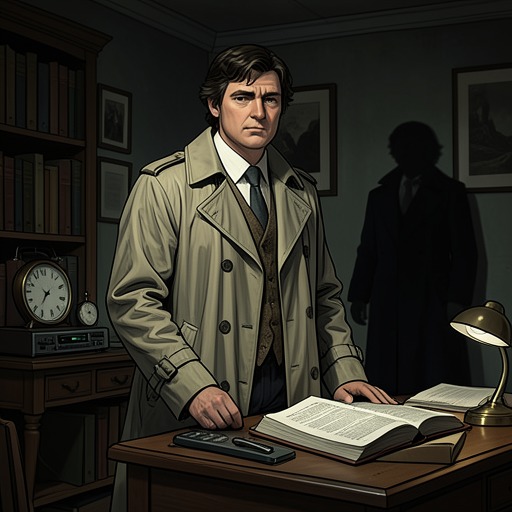
His paperwork and appearance are recurring measures of the distance between his aspirations and his self-image. Before a shift, he leaves money and a joking note for Clut, changes out of his dry-cleaning bag, and admires his reflection in uniform, imagining himself completely squared away. The pose is fragile: Danforth Keeton immediately confronts and humiliates him in the men’s room. Norris is also physically slight and is mocked for seeming ditzy, but Alan Pangborn regards him as a capable small-town peace officer whose feelings are as sensitive as anyone’s.
Norris’s private desk drawer holds an assortment of remedies. When he looks for medicine, he considers a large bottle of strawberry-flavored Kaopectate, puts it away, and chooses generic aspirin instead. Such details make his everyday life deliberately unheroic; his eventual courage emerges from a character introduced through routine, discomfort, and self-consciousness rather than authority or polish.
The Fishing Rod and Gaunt’s Bargain
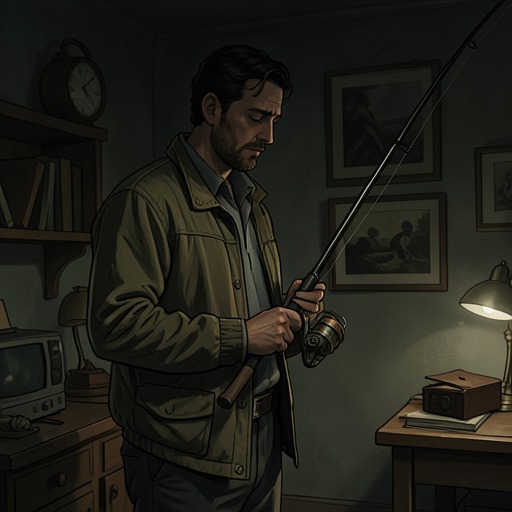
The pivotal object in Norris’s story is a Bazun fishing rod. While patrolling Main Street, he sees one in Leland Gaunt’s shop and recognizes it as the kind his father owned. Norris’s father died sixteen years earlier, when Norris was fourteen, and the rod matters to him both for what it is and for what it represents. Gaunt offers the rod and reel, turning a private ache into an apparent opportunity to recover something of that lost connection.
At first, the purchase leaves Norris cheerful and eager to fish. His good mood is noticed by others, as is his hurt at Keeton’s treatment of him. The promise of a weekend outdoors makes the rod seem like a harmless pleasure, but Gaunt’s bargain does not remain separate from the town’s conflicts. Norris comes to believe that the Bazun is too valuable to risk using; at Castle Lake he has put it aside in favor of an old Zebco. The prized object is thus kept close but withheld from its intended use, an attachment that reveals how possession has displaced the simple activity he wanted to enjoy.
Gaunt later reminds Norris of a promise, and Norris goes to Hugh Priest’s Buick with a fish-gutting knife taken from his reel. He slashes the car’s tires, suppressing his own hesitation and allowing enthusiasm to build as he works. The act is a sharp reversal of the harmless fishing trip he had anticipated: the rod that promised a return to his father’s memory has become part of a chain of retaliatory damage. Norris’s violation is his own action, even as the bargain and Gaunt’s manipulation help bring it about.
Humiliation, Suspicion, and Consequences
Norris’s work brings him into conflict with Keeton, who interprets him as a possible enemy. A traffic-violation notice bearing Norris’s stamped signature identifies him as the officer who cited Keeton’s Cadillac. Keeton responds with threats and imagines a violent punishment if Norris comes to gloat. The scene shows how the town’s everyday machinery—reports, citations, and official signatures—becomes fuel for suspicion and revenge.
Keeton’s fixation on Norris intensifies after Norris calls him Buster and appears, to Keeton, to regard him with contempt. Keeton considers checking Norris’s employment record, wondering whether he was present when the state tax bureau’s letters first arrived. The discrepancy between the deputy’s unassuming appearance and the danger others project onto him becomes part of Norris’s vulnerability: people underestimate him, but in a town consumed by grievance even a routine act of policing can make him a target.
Norris himself is injured in another of Gaunt’s traps when a mousetrap catches his fingers. The injury swells and throbs, but he continues to perform his duties. Later, he receives a wrapped present bearing the cryptic typed reminder “!!!!!JUSTA REMINDER!!!!!” The package and the trap deepen the sense that the violence of Castle Rock reaches into ordinary spaces and objects, leaving Norris both physically hurt and increasingly exposed to the consequences of the bargains around him.
Guilt and Resolve
The cost of Norris’s vandalism becomes unmistakable as violence spreads through Castle Rock. At Nettle Cobb’s funeral, he is one of only five mourners and looks pale and distracted; afterward, he wanders away as though unsure where he is going. He is not merely a witness to the town’s damage. He understands that slashing Hugh’s tires helped set events moving toward injury and death, and the responsibility weighs on him.
Norris’s guilt becomes explicit when he is alone in the shed attached to the house where he has lived since his mother died of a stroke in 1986. He admits to himself that he participated and connects his action to Hugh Priest’s condition and Henry Beaufort’s possible death. He recalls that he had wanted to be a policeman since childhood in order to help people, and contrasts that purpose with his decision to obtain the Bazun cheaply. Seeing the rod again, he cries out and nearly falls from his stool. The object that first embodied affection and loss now confronts him with the consequences of his own compromised judgment.
Rather than let guilt end in surrender, Norris makes it a reason to act. He whispers that he will get Gaunt, then sets off toward Needful Things, despite recognizing that confronting Gaunt alone is reckless. The resolve is not presented as a sudden transformation into an invulnerable hero; it grows out of the very self-reproach that has made him feel unworthy of his vocation. He wants to prevent further harm and, if possible, make amends for what he did to Hugh’s car.
Final Actions and Narrative Role
During the final violence, Norris is shot by Ace Merrill while standing near a brick wall with Buster Keeton and Trooper Price. Wounded but conscious, he remains with the effort to pursue the armed men. As he travels toward Needful Things with Seaton Thomas, he feels increasingly ill and holds on to the belief that Alan needs him. The sequence links his determination to his earlier mistake: he sees the chance to help as a possible means of expiating the damage he helped cause.
Near the burning Municipal Building, Norris recognizes Ace as the man who shot him and killed Buster. Ace is holding Polly Chalmers hostage. Norris positions himself at the cruiser window, braces his service revolver along a flasher bar, and fires. The shot kills Ace and frees Polly from his immediate control. Although Norris has never met Ace before, he has pieced together the man’s identity from the violence unfolding around him and acts at the moment when he can protect someone else.
Afterward, Alan sees blood soaking into Norris’s first-deputy shirt. Norris’s arc ends not with the erasure of his earlier failure but with an action that answers it: the deputy who compromised his wish to help people becomes instrumental in stopping Ace and protecting Polly. His story gives the book’s escalating disorder a small-scale moral pattern. Gaunt’s bargains exploit ordinary wants, but the consequences still belong to the people who act; for Norris, responsibility first becomes guilt, then the impetus to resist.